sa.el

Hability,
A Wellness App
to quit bad habits
CLIENT
TOOLS
National Wellness
Institute
Figma, Miro
ROLE
DELIVRABLES
UX/UI Designer
IOS App
Hi-fi interactive prototype
DURATION
TEAM
9 days
Cécile Lesueur
and I
BRIEF
Even though NWI has numerous years of experience in the wellness field, their program has been slow to catch up with technology.
They have decided to focus on two things:
Create a set of digital wellness tools for Wellness coaches
Update their image, create a new visual system that reflects their innovative and refreshed approach to wellness
The project required the development of a minimum viable product, meaning one main feature with one main user flow. The product needs to allow users to set up their profile and goal as well as to track their progress and to share it with their coach.
To tackle the challenge we followed the non linear design thinking process leading us to the following steps: Empathize, Define, Ideate, Prototype, Test…
Throughout the process with the information collected and the decisions made we filled our UX Strategy Blueprint.

Empathize
First things first, we conducted research based on certainties, suppositions and doubts, in other words assumptions we had that needed to be cleared up. These assumptions mostly revolved around meditation, to get to understand the practice, the purpose, the benefits, the origins and the users’ relation to meditation: Who meditates? How? And why?
On bad habits we tried to understand what triggers cravings, how people get by, what effective tools and techniques they’ve used to get rid of them, what drives them to quit…
Primary Research: Interviews & Survey
We conducted 5 interviews and got the following insights:

The survey on the other hand that rallied 88 respondents showed that:

General Insights
From these first research we drew the following conclusions:
Motivation is a key factor to maintain a goal to break a bad habit long term but people struggle to keep the motivation high enough along the journey with the goals they set to themselves often too high too fast and discouraging at some point.
Replacing a bad habit by a good one and seeing the benefits is motivating and helps in maintaining the good habits and say bye to the bad one.
People are more or less familiar with meditation. Everybody has its own personal way to meditate and people tend to use other tools than an app to do it. Therefore they don’t need another tool to practice meditation but to help them in maintaining the goal meditation can help them achieve.
Secondary Research
The main insights we found relevant to our project showed:
Cravings are induced by stress, boredom or need of comfort.
Mindful Meditation helps in fighting these states that cause cravings and make it difficult to resist to them.
Practicing other enjoyable and beneficial activities for the body and mind also helps and replacing by targeting the trigger that induce bad habit.
It is better to set a 30 days challenge so the brain better accept it knowing it’s temporary and it’s limited in time.
Specifying an objective is more effective.
People should not target perfection to avoid dropping their goal at any failure.
Stress and fatigue affects motivation.
Small continuous steps allow to achieve great results.
Support with engagement towards others or oneself through journaling is a key factor of success.
Market Research
The business analysis showed that there are nuuuuumerous, countless apps already on the market with different contents sometimes addressing particular pain points (stress, sleep) and targeting different audience and types of users but with no unique selling proposition, at least none that we identified.
From here we started identifying some interesting opportunities regarding the positive effects and purpose of meditation and the need from users on bad habits and got a better overview of the market.
At the end of this phase, all these information gathered confirmed our decision to shift from meditation — that was at the core of the project — and turn it more into the seed of our process to come. This means focusing more on the benefits of meditation in eliminating bad habits, rather than solely on meditation.
Define
Persona & User Journey
We synthesized the information gathered in a clearer, more visual and tangible way through a persona and a journey map depicting, and most of all revealing , the pain point to focus on in order to define the problem related to the opportunity identified earlier.
The journey map pointed out the main pain point:
When Mélanie is under pressure she succumbs to her cravings, again and feels bad about it leading to a loss of motivation and a decline of self confidence and consequently a will to give up.


Problem Statement
That’s from this observation that we defined our problem statement to set the issue to solve, the direction to follow and to make sure we’re solving a user problem in line with the client expectations and goals.

Alongside the problem statement, we wrote down its counterpart, the hypothesis statement.

Ideation & Solution
Before engaging the ideation machine and soliciting our brain cells to do their magic, we stated a How Might We statement to align with each other, get a clear direction as well as narrowing the scope and making sure our ideas would be relevant, so we don’t go off track.

After a brainstorming and crazy 8s session we discussed and confronted our ideas and found common grounds on some features that were valuable enough to build a Minimum Viable Product that would both respond to our problem statement and be relevant to the market.
Our solution consisted in:
A personalized daily program aiming at progressively replacing a bad habit by a good one + an extra support to maintain constant motivation.
This idea translates in a user flow in the following way:
Onboarding flow

Main flow of our MVP

And the Information Architecture represented with a sitemap looks like this:
Sitemap

Mid Fi Prototyping and Usability Testings
Based on the previous flows and sitemap, we built a first prototype to test, after a low fidelity one first, in mid fidelity level to have an outlook on the product, start looking at the interface and its usability, at how to implement the feature.

We tested the interactive prototype with 5 users inviting them to complete 3 specific tasks and received some insightful feedbacks to help us improve our product during the next stage: the high fidelity prototyping.

UI/Visual Design & Branding
Competitive Visual Analysis
We retrieved our findings from our competitive research and analyzed the different apps to identify common patterns and best practices in terms of UI and Interactions.
More specifically we looked at homepages and dashboards, resources display, exercices flows, the information architecture…

Moodboard(ing)
In the meantime we defined the brand attributes we wanted to associate our product with according to our persona and shaped a moodboard, visually reflecting these values.

The moodboard served us as a way to set and communicate our visual direction and pick colors, components style, illustrations, typefaces accordingly and build a consistent style guide.
Styleguide

Hi-fi Prototype
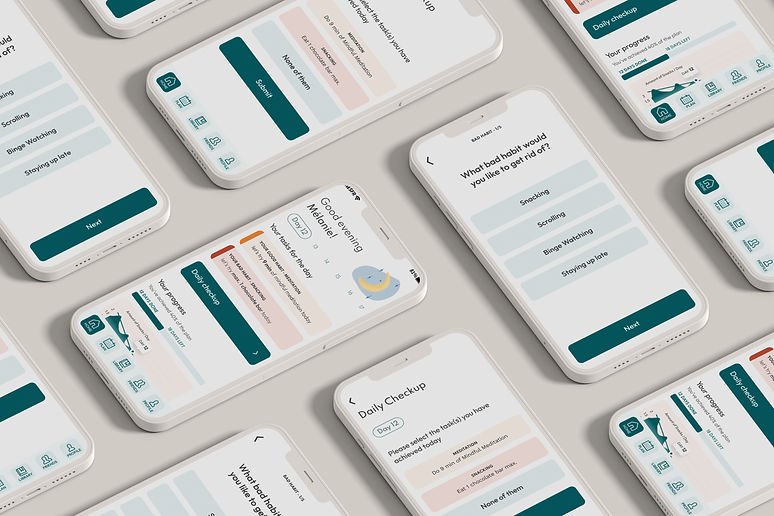
We designed our hi-fi prototype by tweaking and improving our mid-fi with the insights from the usability testings in mind. We also implemented the style defined in our style guide, the interactions and micro interactions to improve the usability and enjoyability of our product. While designing the hi-fi and incorporating the style we made sure our product followed accessibility requirement, making us adapting a few colors.
You can test and play around with the prototype right here for the onboarding and here for the main flow.
Onboarding process flow

Main flow of our MVP

We finished this project with a desirability test that comforted us in our visual choices as the perception of our testers was in line with our brand attributes.You can test and play around with the prototype right here for the onboarding and here for the main flow.
Next Steps
Conducting usability testings on the hi-fi prototype
Refining the prototype, especially on the content with some subject matters experts
Reviewing the product with stakeholders to check the viability and value of the product
Check the technical feasibility
Learnings
Working in pair in such a tight deadline isn’t easy and can be frustrating when the fatigue starts to hit, but I learned that it is above all rewarding to mutualize our ideas and points of view to shape a beautiful and thoughtful product. Communication is key.
Also, this project taught me to never underestimate the power of the research as that’s what made us find a valuable opportunity.